Friday, December 1, 2017


    You know those annoying insects that always seem to be flying and buzzing around you, or even those that just seem to show up when you least want them? Well little did you know, they serve a much larger purpose than we originally thought! 

     I am Emily Cumming, a student at the University of Nebraska – Lincoln. I am a Forensic Science and Entomology dual major. I am from Saint Edward, a small town in Nebraska, where agriculture is all around me. I grew up on a farm just outside of town with my five other siblings. My dad would have my siblings and myself help with different chores on the farm, sometimes with livestock and other times out in the field with crops. I always enjoyed working with the livestock side of the chores, but being the out-of-the-box sibling that I was, I wanted to connect with livestock in agriculture in a different way. Little did I know, it would be both the livestock and crop related.

     As I grew up, I would attend the Nebraska State Fair with my family, looking at all of the farm equipment and different 4-H projects that were made. We always made sure to stop by the Nebraska Beekeeper’s Association booth in the Open Class building. I seemed to always go to the observation hives they had set up. Through my interest in the honeybees, I was able to apply for, and received, a scholarship through the Nebraska Beekeeper’s Association to start a hive of my own. I really enjoyed learning about the importance and role that honeybees play in agriculture and the world in general. Having this exposure to insects while I was still young, led me to discover my passion for insects. 

    When I graduated from high school, I had been a beekeeper for almost five years. Coming to the University, I was unsure of where I wanted to take my career. I ultimately decided on forensic science, but found that it was challenging, yet it did not hold my interest as I had hoped it would. I began to look at my different options. I discovered that I could pursue my passion for insects by taking up the entomology major. Then I found out that I could dual major and keep the classes I had already taken and build on them by adding in the entomology courses. I brought the things I enjoyed from both majors together and now I can learn about them both! I am in love with what I am learning and I can’t wait to share the knowledge with others!

    I am hoping to continue my education after I receive my bachelor’s and work towards my master’s in Entomology. From there I hope to start my career in the military as an entomologist. In the event that the entomologist position is unavailable, I hope to use my forensic science with the entomology by working in a lab. This would be to collect specimens from a crime scene or to analyze any evidence collected to help aid the investigation. I also plan to maintain my small entrepreneurial business of selling honey and honeybee products as well as helping members in my community with pollination by providing a hive for their orchards and gardens. Regardless of which path my career takes; I plan to keep my business going.  I am open to many options for my career, whether that is agriculturally related or not. I hope that no matter what I do, I can share my passion for insects with those around me.

    Don’t be afraid of an insect, because more often than not, the insect more afraid of you than you are of them. Learn a little bit about the role of those annoying insects and see just what they are doing to impact you.

Thursday, November 30, 2017

Hello All,

I am Kaitlin Stocking, and I am a senior Pre-med Biological Sciences major from Livermore, California.  I will be attending physician assistant school upon graduation next may.  I was interested in the course of Insect Ecology not only because it was a highly recommended class by other people who I knew took it, but I have a profound appreciation for the impact that insects actually have on our world.  I have always had sort of a passion for animals in general, stemming from having a passion for exploring the outdoors.  It is because of this Insect Ecology course that not only have I gained a further interest into learning about insects and how they interact with their surrounding environments, but from this class I have learned how important each individual insect is to our ecosystems.  In all honesty, there are still some insects that creep me out.  However, the benefits that they provide to all aspects of the world, outweigh any bad aspects that may be associated with them.  There is often a stigma associated with the Insect population on earth, being that they are just creepy organisms.  However, it is through many years of studies and research, that this is shown simply to not be true. I am truly excited to keep on learning about Insects, and hopefully I get to take another class that focuses on them in the near future.
- Kaitlin Stocking

Becoming A Beekeeper

Hi everyone! My name is Morgan and I am a senior Agricultural Leadership, Education, and Communication major with a focus on leadership and a minor in Insect Sciences at the University of Nebraska-Lincoln. I grew up in a small town about an hour away from Lincoln, NE. I never thought I would have an interest in agriculture until I chose, on a whim, to go to an FFA meeting my freshman year of high school.
I have lived in my small town my entire life and I really didn’t have much background in the agricultural industry. I first became involved in leadership event and public speaking events in FFA. My first speech I gave was on honeybees and colony collapse disorder. This speech sparked an interest in bees for me. By my sophomore year of high school, I had purchased two hives and began my own backyard beekeeping business. I was fascinated with the movement of the bees, their resilience, and their social organization. My beekeeping business became a family business and something we were all excited about! We quickly became the local beekeepers in my small town and whenever someone had a question about bees or had bees in a tree in their backyard, or wanted to buy some local honey, they came to my family.
I brought this passion for insects with me to the University of Nebraska-Lincoln and I was excited to declare a minor in Insect Sciences. I have had the chance to not only expand my understanding of a variety of insects but also a growth in my appreciation of insects that aren’t black and yellow with honey producing powers.


Tuesday, November 28, 2017

Hi Everyone! My name is Bridget, and I am a Biology major at UNL and will be attending pharmacy school next fall. I grew up on a farm in central Nebraska, so I have always been surrounded by agriculture. I have always had a passion for animals and the outdoors. As a kid, I would roam around our pastures with my siblings and search for bugs such as caterpillars, lightning bugs, or ladybugs. The Entomology class I am currently in has re-sparked my interest in bugs, especially how they interact with the environment. I really enjoy learning how their relationships with plants and other organisms affect the world as a whole. I think a lot of people overlook the major role that insects play in the ecosystem, so it is easy to think of them as annoyances. However, after learning so much more about them, I have come to appreciate their contribution to to the Earth. I am excited to keep learning more about them.

Wednesday, November 1, 2017

Hello! My name is Andrea and I'm an Applied Science major at UNL. I first decided to take the course after I bought an insect ID book. I began taking that, along with my plant, mammal, and bird ID books when I went camping or hiking. I've always kind of gotten the hibbie jibbies with some creepy crawlers, so I thought Insect Ecology course offered at UNL would help me become more familiar and comfortable with insects. In fact, I'm also currently enrolled in Insect Biology and have the opportunity to keep a couple of insects as 'pets.'

Although spiders still sometimes make me jump, I've grown a different kind of appreciation for what insects do for us and Earth. I hope to one day be able to work in a national park or doing research toward environmental awareness.

-Andrea Lopez

Friday, October 6, 2017

Hello, my name is Kassidy Kruger! I am currently majoring in Pre-Physician Assistant Biology and will be pursuing my master’s degree after graduating in the spring. My interest in entomology stems from being an outdoorsy kid who loved digging in the dirt. I had a peculiar (and messy) habit of bringing inside uncovered creatures from my backyard in attempt to add to my “biosphere” contained in a gallon aquarium. It wasn’t until after my aquarium had burst from the seams that I was forced to take a more virtual and book orientated path to learning about bugs.

I find that, more times than not, people place an unneeded stigma on insects by calling them “pests”, destroying any educational or moral potential it had once embodied. By learning the importance of bugs within our environment’s complex network from the get-go, I feel that I am one step ahead. I am eager to continue learning about insects and can’t wait to see the full scope of what this class has to offer.

Sunday, October 1, 2017

Insect Ecology

   Hello everybody, my name is Jeff Olson and I am a biological sciences major at the University of Nebraska in Lincoln. I'm from the Black Hills in  Rapid City, South Dakota. The outdoors and the environment have always been important to me because it is vital to many of my main interests, but I also come from a conservationist background. I also firmly believe that the state of the global environment is a major problem that that we will have to face.
   As far as entomology goes, my interest peaks at its importance to ecology in many areas, my interest declines with any mention or involvement of ticks. Phobias aside, insects are an extremely diverse group with ranging specializations to find intriguing. If you don't think so, I might suggest a David Attenborough commentated documentary on any insect. Overall, I know that insects have major world impacts on other organisms like animals and the food that we eat. That is enough for me to want to know more about the world of entomology.

Monday, July 31, 2017

Beware of ticks!

We are right in the middle of the summer, which means ticks are very active! Here in Nebraska we have two species, the Lone Star tick and the American dog tick. Both spread a number of diseases, and I am one of the latest victims!

I discovered a tick bite about a week ago after being in a tick infested area about a week or so prior to that. The tick was no longer in the bite, which means it had had plenty of time to feed and spread infection. I found a red, expanding rash on the back of my neck, and had enlarged and sore lymph nodes and a headache. We do not have the black-legged tick, which is the vector for Lyme disease, here in Nebraska, but the Lone Star tick spreads a similar disease.

The treatment for any tick-borne illness is antibiotics (doxycycline or amoxicillin), and the sooner you notice symptoms and get the medication, the less complications you may experience. Many of you may be in Lyme country (such as Northern states like MN and WI), so it's very important that you keep an eye out for an expanding red rash (called a erythema migrans), especially if it shows a bulls-eye pattern, and see your doctor.

Also, use repellent (such as DEET) before entering tick-infested areas and be sure to do a thorough "tick check" afterwards. Ticks wander around the body a bit before they attach, so many times you can get rid of them before they bite you. If you see one attached, use a tweezers to remove it. Ticks usually need to be attached for at least 24 hours before they can spread a disease.

See the following good resources for more information about ticks and tick-borne disease:

Ticks (Nebraska Extension)  

Ticks and Tickborne Diseases (CDC) 

                      Lone star tick (female), which spreads a Lyme-like disease here in Nebraska called STARI.
In mid-July, UNL and Nebraska Extension held the second annual Bugmasters training camp. This training was geared towards preparing volunteers to teach youth and adult insect programs. It included presentations about basic insect biology and specific pests, and also a hands-on component where we visited the backyard farmer garden, pollinator garden, and beehives.

Read more about it, here: http://ianrnews.unl.edu/bugmasters-program-helps-prepare-volunteers-teach-youth


Wednesday, May 3, 2017

Spring has sprung, although here in Nebraska we've had a lot of cold, wet weather. But temperatures are getting better and the insects are starting to emerge.

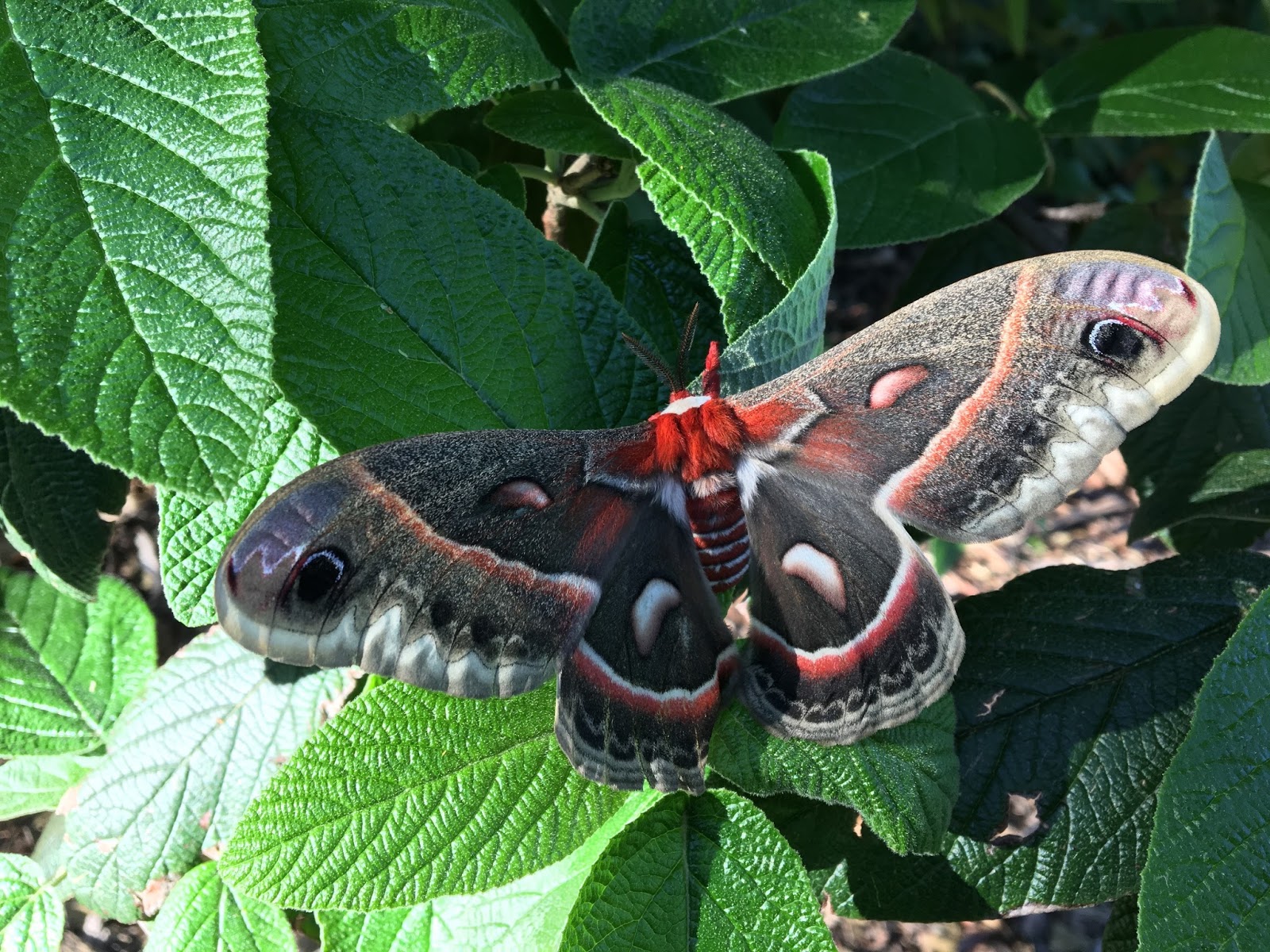
Last spring, I raised some Cecropia (Hylephora cecropia) caterpillars. One of my colleagues found a female and she laid eggs, so he took some to raise in his lab and I raised about 10 of them in my office. This is the largest moth in North America, but they start out as tiny black caterpillars:

Throughout the summer, I fed them (they eat a number of plants, including ash, box elder, lilac, cran- apple, and maple), and they progressed through several stages, or instars.


They become vibrant green with pretty yellow and orange/red "knobs." In their final instar, they are several inches long!


Once they are this big,  it's time to pupate! They spin a cocoon among the branches/leaves of their food source, then pupate within it.

Out of my 10 caterpillars, 4 of them lived to pupate. Their growth and development occurred from about May through July. This species only has one generation per year, so the moths will not emerge until the following Spring.

I put the cocoons in the refrigerator all through the winter, as this emulates the cold months when they are in diapause. This April, I removed them and 3 weeks later, the first of the four emerged. It was a male I named Titus.


Unfortunately, I could not release him as we've had a few cold, rainy days, and it would have been certain death. The adults do not feed and only live about a week, so their main purpose is to find mates and lay eggs. I was hoping a female would emerge, and one did a couple days later. Here is Athena. She is much larger than Titus, and he was large enough!


Sadly, when I got back from the weekend, Titus had banged his wings up all around the cage, and did not have a lot of time left. I am not sure that he and Athena actually mated. I released both of them yesterday when it was warmer. I wanted to give Titus some time outside before dying, but Athena I am hoping found a chance to mate.


I still have two cocoons left and hopefully these moths will emerge as well. It was an amazing experience being able raise this insect from caterpillar to moth!

Friday, March 17, 2017

Think twice before killing that little spider you see in your house!! He's eating a lot of pest insects you don't want around! (Photo: UNL)